Address
Vadodara, Gujarat


Material efficiency is an important consideration when developing structural systems for solar infrastructure. A well-engineered structure needs to provide the required strength and stability while using structural members, dimensions, and thicknesses appropriate for the project’s actual requirements. The objective is not simply to use more material, but to develop a structural system in which material is used effectively.
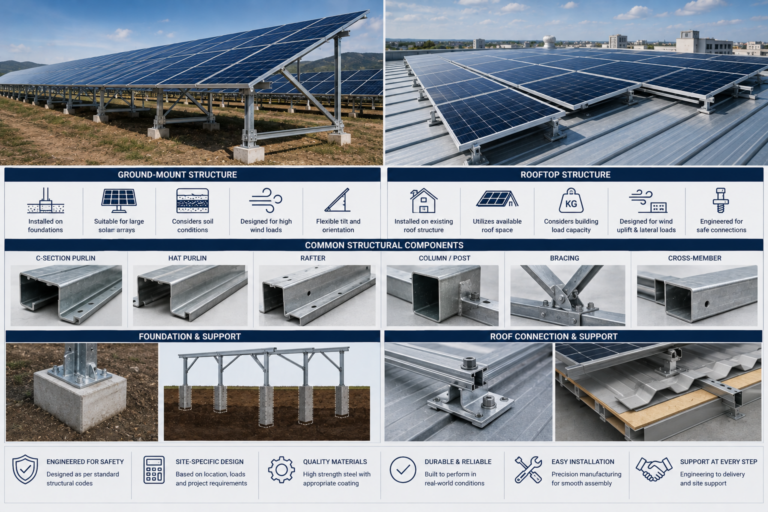
Solar mounting structures are made up of multiple interconnected components, including purlins, rafters, columns and posts, bracing members, and connection hardware. Each component performs a specific structural function, and its dimensions and thickness need to be selected according to the loads and conditions it is expected to handle.
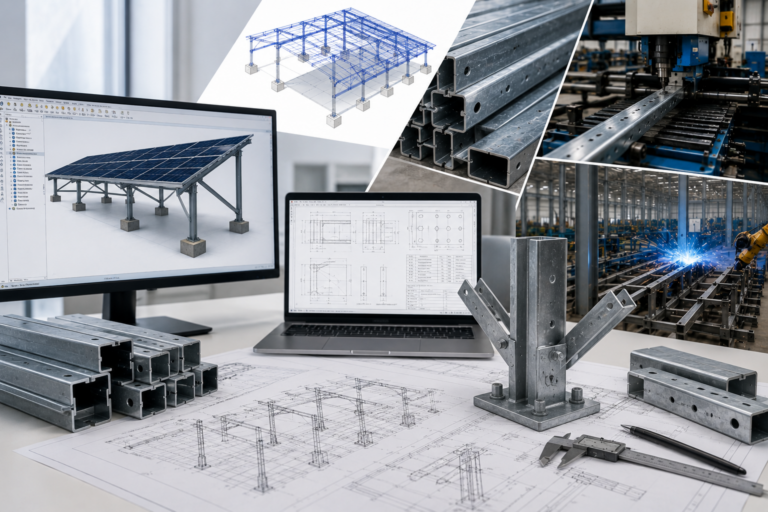
Engineering plays a central role in achieving material efficiency. Factors such as span, module arrangement, wind conditions, structural loads, tilt angle, connection details, and foundation requirements can influence the final section selection. By considering these factors during design, engineers can develop structural configurations that are appropriate for the intended application.
Section geometry is another important consideration. Different profiles can provide different structural characteristics depending on their shape, dimensions, and thickness. ARKION’s product range includes C-section purlins, rafters, hat purlins, columns and posts, and bracing and cross-members, allowing structural systems to be configured around different project requirements.
Material thickness also needs to be considered carefully. Using a thickness that is not suited to the actual structural requirement can affect the efficiency of the system, while selecting an appropriate thickness can help balance structural performance, weight, fabrication, and handling. ARKION’s technical information lists structural section thicknesses in the range of 1.6–5.0 mm, with final selection dependent on the project requirements.
Wind conditions are particularly important when considering material efficiency. A solar structure must be designed to withstand the environmental loads applicable to its location. ARKION’s technical information indicates wind design speeds of up to 180 km/h, with site-specific design based on IS 875. This highlights the importance of developing the structural system according to actual site conditions rather than relying on a generic configuration.
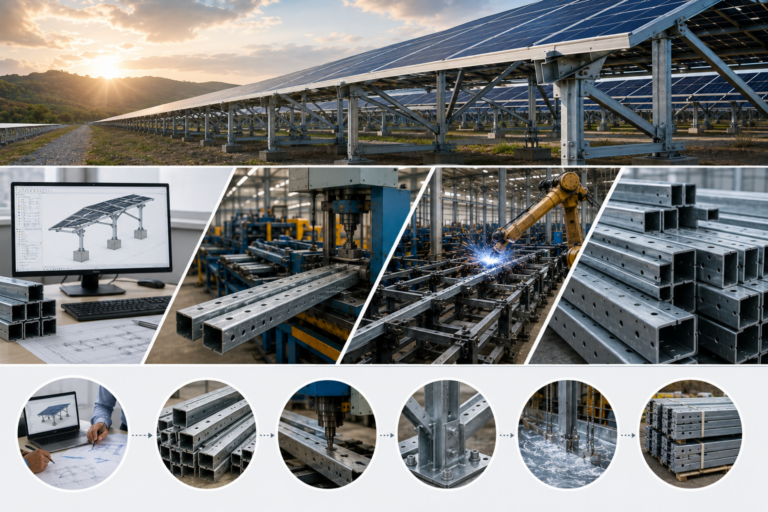
Material efficiency also depends on manufacturing accuracy. A well-designed section needs to be manufactured consistently so that its dimensions, holes, connections, and other features correspond with the engineering requirements. Processes such as roll forming, CNC punching, cutting, welding, and assembly therefore play an important role in translating an efficient design into a practical structural component.
Surface protection should also be considered as part of the complete material strategy. Pre-galvanized steel and hot-dip galvanizing are identified in ARKION’s technical information as coating options. Selecting the appropriate protection method helps address the durability requirements of steel components used in outdoor solar applications.
At ARKION, material efficiency is approached through the connection between engineering, manufacturing, and quality. Structural components are developed with attention to project requirements, while manufacturing and quality processes help maintain consistency in the finished product.
Efficient structural engineering is ultimately about achieving the right balance between performance, material use, manufacturability, installation, and durability. When these factors are considered together from the beginning, solar structures can be developed with a practical and responsible approach to material selection while maintaining the structural performance required for the application.