Address
Vadodara, Gujarat

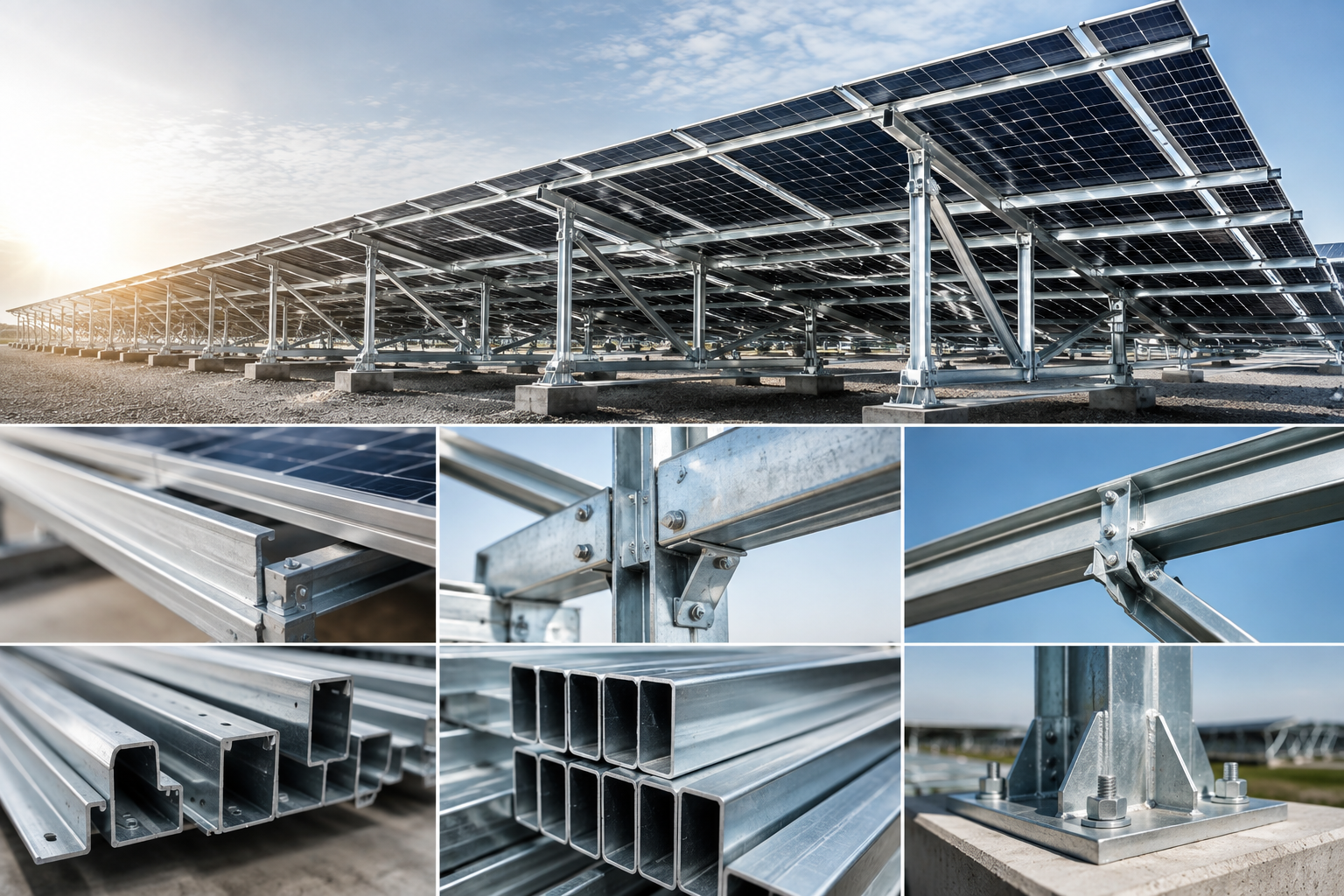
Solar mounting structures are one of the most important components of a photovoltaic installation. While solar modules are the most visible part of a solar project, the structure beneath them is responsible for supporting the modules, transferring loads to the foundation, and maintaining the required orientation throughout the service life of the installation. A well-engineered mounting structure therefore plays an important role in the safety, stability, durability, and long-term performance of a solar project.
A solar mounting structure is designed to support photovoltaic modules at a defined tilt and orientation while withstanding environmental and structural loads. Depending on the application, structures may be designed for ground-mounted or rooftop solar installations. The final structural arrangement depends on factors such as the site conditions, module configuration, span requirements, loading conditions, wind exposure, foundation arrangement, and applicable engineering standards.
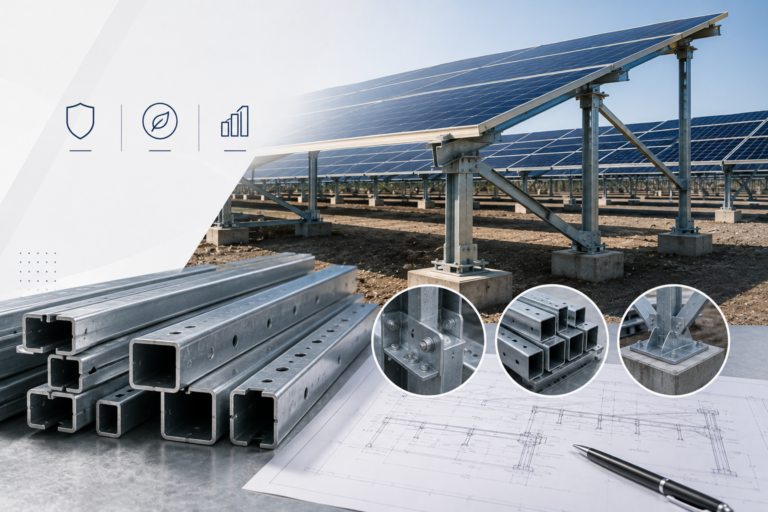
A typical structural system consists of several interconnected steel components. C-section purlins act as supporting members for the solar modules and transfer loads to the primary structural members. Rafters form an important part of the primary load-bearing system, transferring structural loads towards the supporting columns and foundations. Hat purlins can be used as secondary structural members where lightweight and material-efficient solutions are required. Columns and posts transfer the structural loads from the upper framing system to the foundation, while bracing and cross-members provide additional stiffness and help the structure resist lateral movement and wind effects.
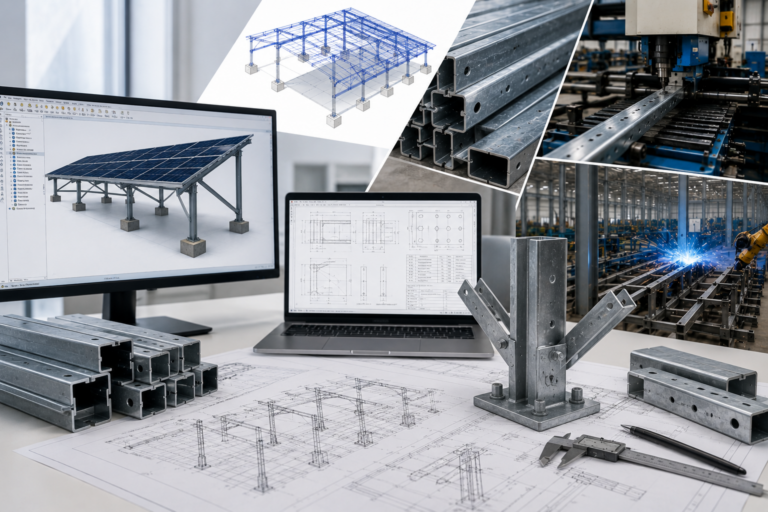
The selection of steel sections is an important part of structural design. Section dimensions, thickness, material grade, connection details, and spacing must be considered according to the requirements of the specific project. Using an appropriately designed structural system helps balance strength, stability, material efficiency, fabrication requirements, and installation practicality. For this reason, solar mounting structures should not be treated as a one-size-fits-all product. Site-specific engineering is essential for achieving an effective and dependable solution.
Wind conditions are particularly important when designing solar mounting systems. Solar modules present a significant surface area to wind, making uplift and lateral forces important considerations during structural design. Wind-zone analysis, structural calculations, connection design, and foundation requirements must therefore be considered together. The applicable requirements can vary depending on the location and project conditions, which is why final structural sections and foundation arrangements should be determined through project-specific engineering.
Material protection is another important consideration for solar structures, particularly because many installations are exposed to outdoor environmental conditions for long periods. Galvanizing and appropriate surface protection can help improve the durability of steel components. The choice between pre-galvanized material and hot-dip galvanizing depends on the component, design requirements, manufacturing process, and project specifications. Proper coating and quality control are important parts of maintaining the long-term performance of structural steel.
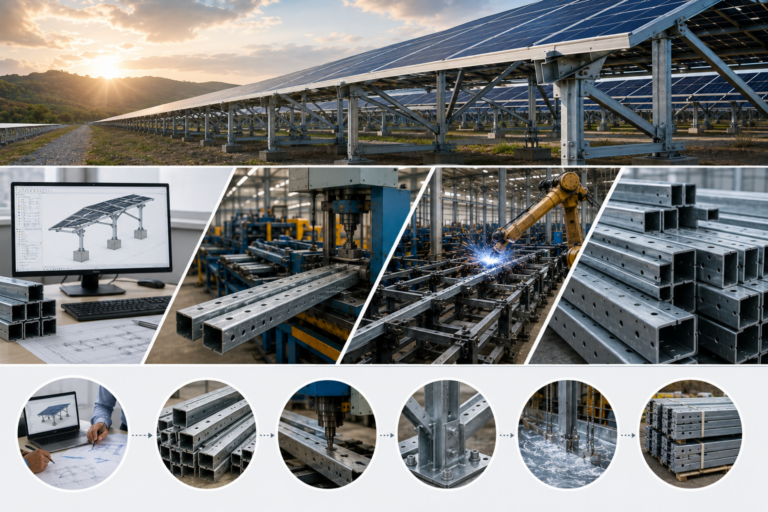
Manufacturing quality also has a direct impact on the final installation. Processes such as roll forming, cutting, CNC punching, welding, assembly, surface protection, inspection, packing, and dispatch need to be controlled to maintain consistency between the engineered design and the manufactured components. Accurate dimensions and connection locations help simplify installation and reduce avoidable issues during project execution.
At ARKION, structural steel solutions are developed with an engineering-led approach covering design and detailing, manufacturing, galvanizing, quality assurance, and project support. The focus is on creating practical structural solutions that can meet project requirements while maintaining attention to precision, material efficiency, durability, and reliable performance.
The performance of a solar mounting structure ultimately depends on how well its different elements work together. Engineering, material selection, manufacturing accuracy, surface protection, connections, and installation all contribute to the overall structural system. When these factors are considered together from the beginning, solar mounting structures can provide a dependable foundation for photovoltaic installations over their intended service life.
As solar infrastructure continues to expand, the importance of properly engineered supporting structures will continue to grow. Strong solar projects begin with strong structural foundations, and the right combination of engineering, manufacturing, and quality can make the difference between a structure that simply supports solar modules and one that is designed to perform reliably for years to come.